
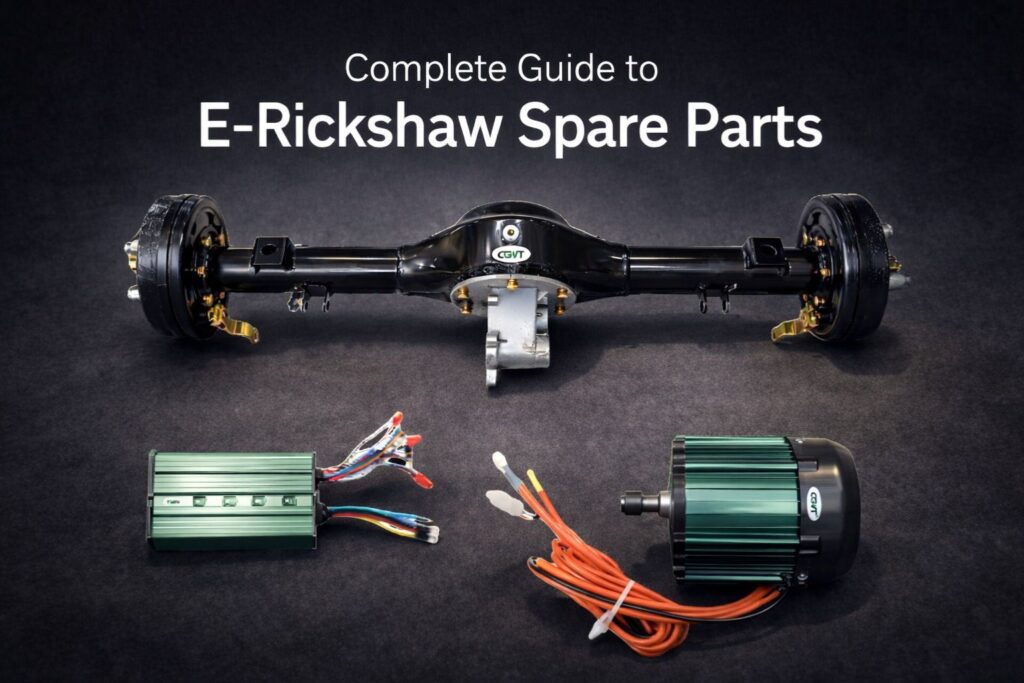
Motors, Controllers & Wiring Explained
By CGVT — India’s Trusted E Rickshaw Spare Parts Manufacturer
cgvt.in | +91-9205043700 | Karol Bagh, New Delhi
India’s e-rickshaw ecosystem is growing faster than ever — and for good reason. These three-wheelers have become the backbone of last-mile connectivity in cities, towns, and semi-urban corridors across the country. But smooth, reliable, emission-free rides do not happen by accident. They happen because of the right electrical e rickshaw spare parts working in perfect harmony under the hood.
At CGVT, we have spent years engineering high-performance, durable, and energy-efficient components specifically designed for real Indian road conditions. From the BLDC motor that powers every kilometre to the wiring harness that holds the entire electric system together, CGVT’s product range is built to do one thing: keep your vehicle running at its absolute best.
Whether you are an OEM manufacturer, a fleet operator, or an individual e-rickshaw owner, this guide will walk you through every major electrical component of an e-rickshaw, explain how each one works, and show you why choosing the right parts — from the right manufacturer — makes all the difference.
Why Electrical Components Define Your E Rickshaw’s Performance
Unlike a petrol or diesel auto-rickshaw, an e-rickshaw has no engine, no carburettor, and no fuel injection system. Its performance is determined entirely by the quality and calibration of its electrical components used in e rickshaw — the motor, controller, wiring, meters, throttle, and associated accessories.
This means that every acceleration response, every hill climb, every kilometre of range, and every trouble-free operating hour is a direct result of how well these EV electrical components are designed, manufactured, and maintained.
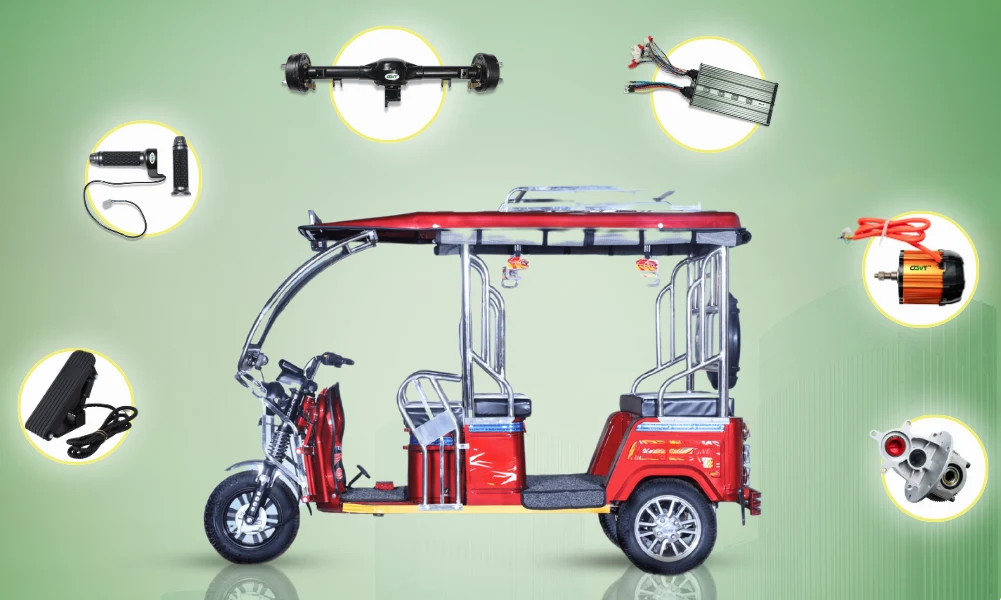
The important electrical parts of e rickshaw form a tightly integrated system:
- The motor converts electrical energy to mechanical motion
- The controller manages how power flows from the battery to the motor
- The wiring harness interconnects every component safely and efficiently
- The digital meter provides real-time diagnostics to the driver
- The throttle translates driver input into precise acceleration commands
- The DC converter powers all 12V accessories from the main high-voltage battery
A weakness in any one of these links drags down the entire system. That is why CGVT engineers every component with the same obsessive attention to quality — because a chain is only as strong as its weakest link.
“CGVT’s motors and controllers have significantly improved the performance of our fleet. Better mileage, better power — highly recommended!” — Rajesh Kumar, Fleet Operator
BLDC Motor in E Rickshaw: Features and Working
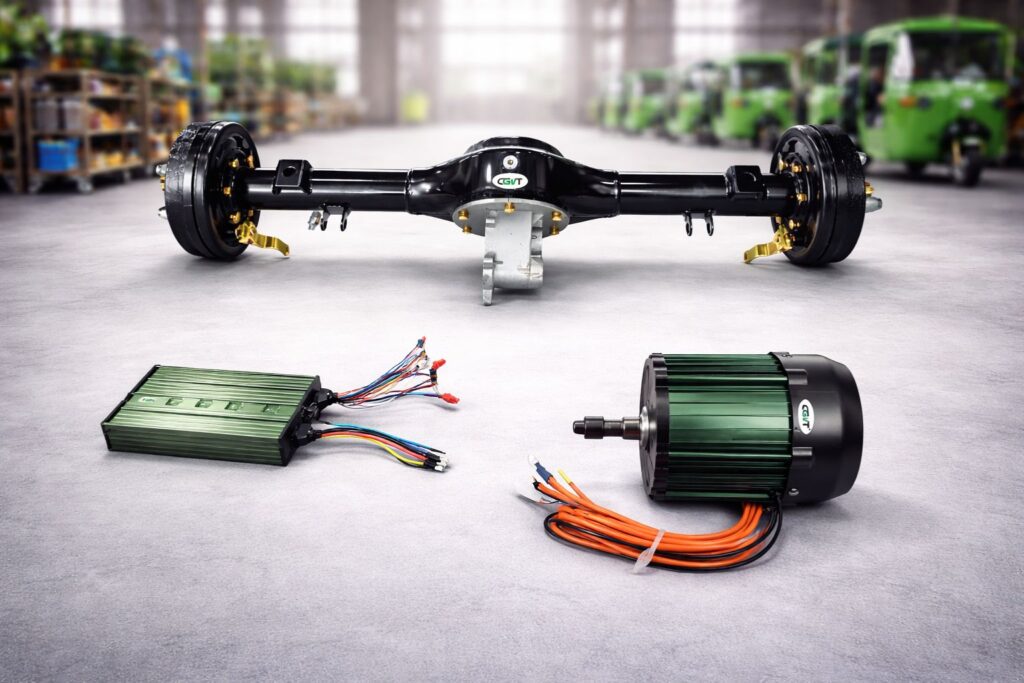
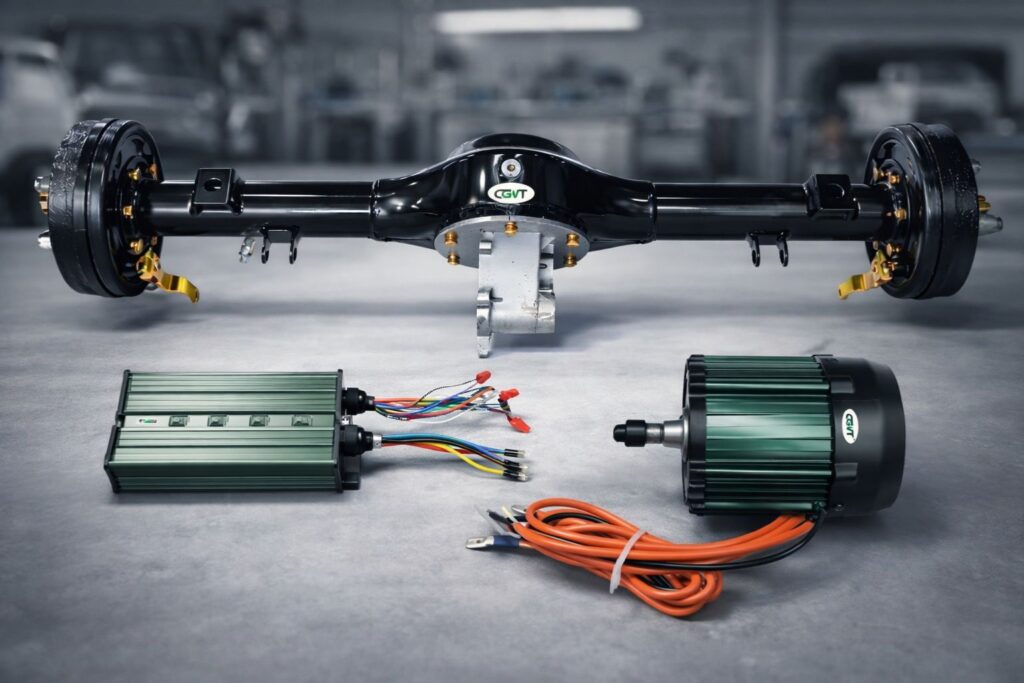
The e rickshaw motor is the primary source of mechanical power in the vehicle, and CGVT’s motor range represents the best of what modern BLDC technology can deliver for Indian operating conditions.
What Is a BLDC Motor and Why Does It Matter?
BLDC stands for Brushless Direct Current. Unlike older brushed motors that relied on physical contact between carbon brushes and a commutator ring, a BLDC motor for e rickshaw uses electronic commutation — eliminating friction, reducing heat, and dramatically extending the motor’s working life.
In CGVT’s BLDC motors, permanent magnets are mounted on the rotor while precisely wound copper coils sit on the stator. When the controller sends current through these coils in the correct sequence, it generates a rotating magnetic field. The rotor follows this field — and that rotation is what ultimately drives the rear axle and moves the vehicle forward.
Most CGVT motors are hub-integrated designs, meaning the motor is built directly into the rear axle assembly, eliminating the need for chains, gearboxes, or separate drive shafts. The result is a mechanically simpler, quieter, and more efficient drivetrain.
CGVT Motor Specifications
CGVT currently offers the following motor variants to match different load capacities and operational requirements:
- 48V 1200W BLDC — Ideal for standard passenger e-rickshaws on flat to moderate terrain
- 48V 1300W BLDC — Enhanced torque output for higher passenger loads and mixed terrain
- 48V/60V 1500W BLDC — Dual-voltage, high-performance option for demanding routes, hills, and e-loader applications
All CGVT motors are built to deliver maximum efficiency and an extended lifespan, with a focus on energy optimisation so your e-rickshaw achieves exceptional mileage on every charge.
Why BLDC Motor Working in E Rickshaw Affects Your Bottom Line
A high-efficiency BLDC motor draws less current from the battery for the same output power. Over a full operating day, this translates to more kilometres per charge cycle — directly increasing the earning potential of every vehicle in your fleet. A degraded or low-quality motor, by contrast, draws excess current, generates unnecessary heat, stresses the battery, and shortens the lifespan of the entire electrical system.
CGVT motors undergo rigorous quality control and load testing before dispatch. When you source your e rickshaw motor from CGVT, you are not just buying a component — you are investing in measurable efficiency gains across the vehicle’s entire service life.
Role of the Controller in E Rickshaw Performance
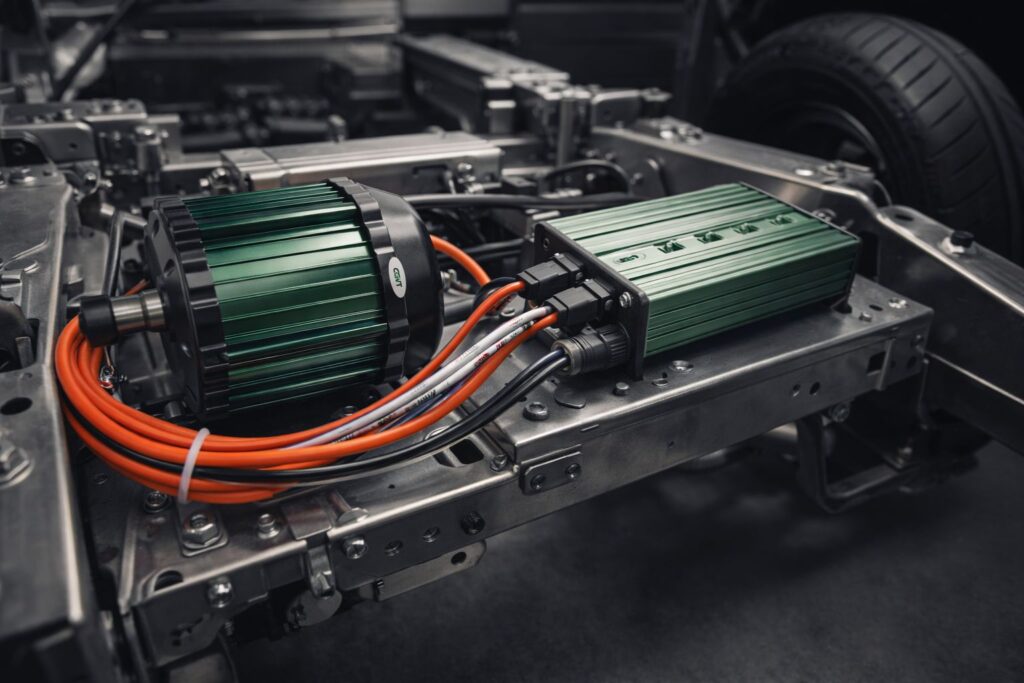
If the motor is the muscle of the e-rickshaw, the e rickshaw controller is the brain. This sophisticated power electronics device sits between the battery and the motor, translating the driver’s throttle input into precise, optimised current and voltage signals in real time.
How the CGVT E Rickshaw Motor Controller Works
Understanding how e rickshaw motor controller works begins with recognising that it is performing hundreds of calculations every second. Here is the process in plain terms:
- Step 1: The driver presses the throttle, which sends a variable voltage signal (0 to 5V) to the controller.
- Step 2: The controller’s microprocessor reads this signal and determines the required motor speed and torque output.
- Step 3: Using Pulse Width Modulation (PWM), the controller regulates the voltage and current flowing from the battery pack to the motor windings — millisecond by millisecond.
- Step 4: Hall-effect sensors inside the motor continuously send rotor position data back to the controller, enabling real-time commutation adjustment.
- Step 5: Simultaneously, the controller monitors battery voltage, motor temperature, and current draw — cutting power or adjusting output if any parameter goes out of safe range.
CGVT’s controllers use 24-tube architecture for high-efficiency performance. This design reduces switching losses compared to standard configurations, delivering more usable power to the motor for the same battery drain — a tangible advantage for fleet operators counting every kilometre.
Protection Features Built Into CGVT Controllers
CGVT controllers are engineered with comprehensive protection circuits that safeguard both the motor and the battery pack:
- Over-voltage and under-voltage cutoff to protect battery health
- Over-temperature shutdown to prevent controller burn-out during heavy use
- Short-circuit and phase-loss protection
- Regenerative braking support for energy recovery during deceleration
- Locked-rotor detection to prevent motor stall damage
These protections are not optional extras — they are integrated into every CGVT controller as standard. When you are evaluating an e rickshaw controller supplier, the presence and quality of these protection circuits is one of the most important differentiators between a reliable part and an expensive failure.
“Their after-sales service is exceptional. Quick response and quality spare parts make CGVT our go-to supplier!” — Amit Sharma, Spare Parts Dealer
Understanding the E Rickshaw Wiring Harness
The e rickshaw wiring harness is one of the most underappreciated components in the electric rickshaw electrical system — yet it is responsible for connecting every single part of the vehicle’s electrical architecture. Think of it as the nervous system: when it works flawlessly, you never think about it; when it fails, everything stops.
What the Wiring System in Electric Rickshaw Includes
- High-current main power cables from battery to controller (thick gauge for minimal resistive loss)
- Three motor phase wires (A, B, C) carrying the switched power to the BLDC motor windings
- Hall sensor signal cables providing rotor position feedback to the controller
- Throttle and brake input signal wires
- Lighting circuit harness for headlight, tail light, and indicators
- Dashboard and digital meter connections
- Charging port harness and BMS communication cables
- Ignition switch circuit with integrated anti-theft provisions
Why Wiring Quality Makes or Breaks an E Rickshaw
The wiring system in electric rickshaw must survive constant vibration on potholed roads, heavy monsoon exposure, extreme summer heat, and the mechanical stress of daily loading and unloading. Low-quality harnesses — often found in cheap spare parts bundles — use undersized conductors that overheat under load, thin insulation that cracks in the cold, and unprotected connectors that corrode in moisture.
The consequences range from annoying intermittent faults to serious hazards including short circuits and fire risk. A well-engineered harness uses FR-PVC (flame-retardant) insulation, tinned copper conductors for long-term oxidation resistance, and sealed multi-pin connectors at all critical junctions.
CGVT’s electrical accessories and harness components are sourced and validated to these same standards, ensuring that the wiring in your vehicle performs as reliably as the motor and controller it connects.
DC Converter, Digital Meter & Electrical Accessories in E Rickshaw
Beyond the motor and controller, the complete guide to e rickshaw electrical system must cover the supporting components that make the vehicle fully functional and safe for daily commercial operation.
DC Converter (DC-to-DC)
The main battery pack in an e-rickshaw operates at 48V or 60V. However, all 12V accessories — horn, indicators, lights, dashboard meter — require a stable lower voltage supply. The e rickshaw DC converter bridges this gap, stepping down the high-voltage battery output to a regulated 12V rail.
A failing DC converter is commonly misdiagnosed as a wiring fault. Symptoms include flickering lights, an unresponsive horn, or erratic dashboard readings. Replacing a faulty converter is one of the most cost-effective repairs available and immediately restores full accessory functionality.
CGVT Digital Meter with Fault Indication
CGVT’s digital meters do far more than display speed and battery level. They provide real-time fault indication for both the motor and controller, enabling drivers and technicians to identify problems before they escalate into expensive breakdowns. Fleet operators using CGVT meters report significantly reduced unplanned downtime because issues are caught early.
Key parameters displayed include vehicle speed, battery state of charge, odometer, trip data, and fault code readout for motor and controller diagnostics.
Throttle — Hand and Foot Variants
CGVT offers a complete throttle range designed for smooth acceleration, improved handling, and precise control across all operating speeds. Specifications:
- Hand Throttle (Left & Right): Voltage range 24V/36V/48V/60V/72V, 2.2cm grip diameter, 45cm wire length, plastic and aluminium construction
- Foot Throttle: Voltage range 12V to 60V, output voltage 0.8V–4.2V, working range 0–5V, metal body for durability
The foot throttle is particularly popular with operators who prefer a car-like driving experience, reducing hand fatigue on longer routes.
Switches, Ignition, Wipers & Locking System
- CGVT Switch (Left & Right, with and without lever): Copper-plated indicator switches rated for continuous switching duty, 60 x 23 x 23 cm form factor
- Ignition Switch: Enables the vehicle’s complete electrical system safely and reliably — engineered for longevity in high-use commercial environments
- Wiper Motor (Copper Winding) & Wiper Blades: Copper-wound for maximum torque and durability; smooth rubber grip blades for clear all-weather visibility
- Central Locking System: Advanced security with laser-marking capability for custom brand identification — a popular choice for fleet operators who want standardised, trackable vehicles
How CGVT Electrical Spare Parts Affect E Rickshaw Efficiency
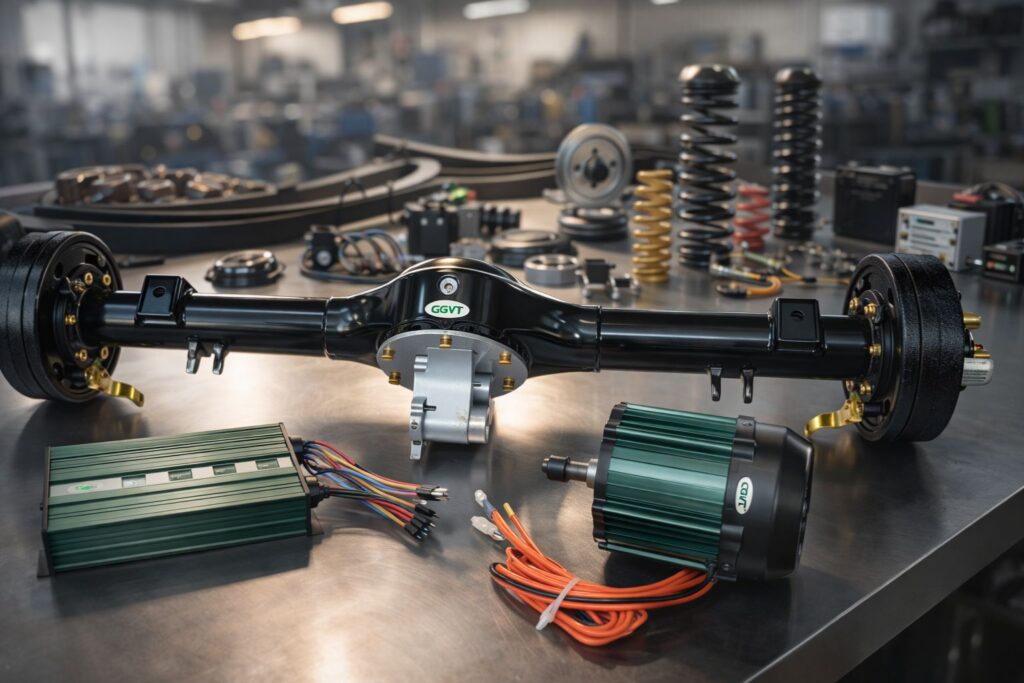
Efficiency in an electric vehicle means extracting maximum range and performance from every kilowatt-hour stored in the battery. The quality of your electrical e rickshaw spare parts has a direct, measurable impact on this number — and CGVT’s engineering philosophy is built around this reality.
The Energy Pathway
Consider how energy travels through the vehicle: the battery discharges, current flows through the high-current harness cables, the controller modulates that power, the motor converts it to mechanical energy, and the wheels move forward. At every stage, energy is either used productively or lost as heat due to resistance.
A corroded connector, an undersized wire, or an inefficiently wound motor all add resistance losses. At 50 amperes of operating current, even a few milliohms of extra resistance generates watts of wasted heat. Across a full operating day, this compounds into meaningful range loss — lost kilometres that directly translate to lost income for an operator.
CGVT’s Reliability Promise
CGVT products undergo rigorous testing and quality control before leaving our facility. Our in-house R&D team works continuously on new advancements, and our manufacturing processes are designed to ensure that every motor, controller, and accessory meets the same performance specification from the first unit to the thousandth.
Our USPs that directly protect your efficiency and profitability:
- Advanced Engineering: State-of-the-art technology for maximum performance and efficiency
- India-Ready Solutions: Global technologies localised for Indian roads, loads, and climate
- Reliable & Durable: Rigorous testing ensures long service life and minimal maintenance costs
- Competitive Pricing: Top-tier products at accessible price points for maximum customer value
- Customer-Centric After-Sales: Dedicated service team from product selection through to ongoing support
“I switched to CGVT’s differentials, and the difference is night and day! Smooth operation, reduced noise, and long-lasting durability.” — Sandeep Verma, Vehicle Owner
Troubleshooting E Rickshaw Electrical Parts: A Practical Guide
Even the best components require periodic attention. Here is a systematic approach to troubleshooting e rickshaw electrical parts that every technician and fleet manager should know.
Motor Issues
- Hot motor after short trips: Check controller current limit settings, verify all three phase wire connections are secure, assess vehicle load weight.
- No movement despite throttle input: Inspect Hall sensor cable continuity; check all connectors for corrosion or loose pins.
- Vibration or grinding from rear axle: Inspect wheel hub bearing condition and verify axle mounting bolt torque.
Controller Issues
- Fault code on digital meter: Refer to CGVT’s fault code chart (supplied with every controller). Most E01-E08 codes relate to phase wire or sensor connections.
- Sudden acceleration or no response: Test throttle potentiometer output voltage; check throttle wiring for damage.
- Controller running excessively hot: Verify that the heat-sink mounting surface has full contact, check ambient conditions, and confirm current limit settings are within specification.
Wiring & Accessory Issues
- Flickering lights or accessories cutting out: Measure DC converter output voltage under load; inspect all ground connections.
- Faster than normal battery drain: Use a clamp meter to check for current leakage in the harness. Check for pinched or chafed wires.
- Meter showing fault codes intermittently: Inspect the meter signal cable connectors; check for loose pins at the controller-side harness junction.
CGVT’s customer support team is available on +91-9205043700 for technical guidance. Our dedicated service approach means you are never troubleshooting alone.
Why Choose CGVT for Your E Rickshaw Electrical Parts?
The Indian market offers a wide range of electrical e rickshaw spare parts — from premium engineered components to low-cost imitations. The choice you make has consequences that extend far beyond the purchase price.
CGVT is a next-generation manufacturer headquartered in Karol Bagh, New Delhi, specialising exclusively in differential systems, motors, controllers, and a complete range of electrical and mechanical accessories for E-Rickshaws, E-Loaders, E-Carts, and E-Autos (L5). We do not import and resell — we engineer, localise, and manufacture.
What Sets CGVT Apart
- In-house R&D team continuously refining products for Indian operating conditions
- Complete product portfolio covering every major electrical component used in e rickshaw — single-source procurement simplicity
- Laser-marking capability on select components for OEM brand customisation
- Non-asbestos brake shoes for environment-friendly compliance
- Wholesale and bulk supply capability for fleet operators and distributors
- Expert after-sales support — not just replacement parts, but technical guidance
Our vision is simple: to be at the forefront of India’s e-mobility transformation by building products that not only meet but exceed the expectations of operators, OEMs, and fleet managers. When you choose CGVT, you are not just buying a motor or a controller — you are gaining a long-term partner committed to your operational success.
Conclusion: The Right Parts, The Right Partner
The e-rickshaw is a deceptively simple vehicle on the surface — but a sophisticated piece of EV engineering beneath. Its performance, reliability, and earning potential are entirely determined by the quality of the electrical components used in e rickshaw that power it every day.
From the BLDC motor delivering efficient torque to the rear wheels, to the smart controller managing every watt of battery power, to the wiring harness carrying signals and current safely across the entire system — every component matters. Understanding the guide to e rickshaw electrical system is the first step to making better decisions about maintenance, upgrades, and procurement.
CGVT exists to make that journey easier. As a trusted e rickshaw electrical parts manufacturer India operators and OEMs rely on, we combine advanced engineering with India-ready durability and genuine customer partnership.
Whether you are upgrading a single vehicle or sourcing wholesale e rickshaw spare parts for an entire fleet, CGVT has the components, the expertise, and the commitment to get you where you need to go.
Ready to Upgrade Your E Rickshaw’s Electrical System?
Connect with CGVT today for genuine, high-performance electrical e rickshaw spare parts.